Estimation
Estimate the potential reach of an audience while you define it.
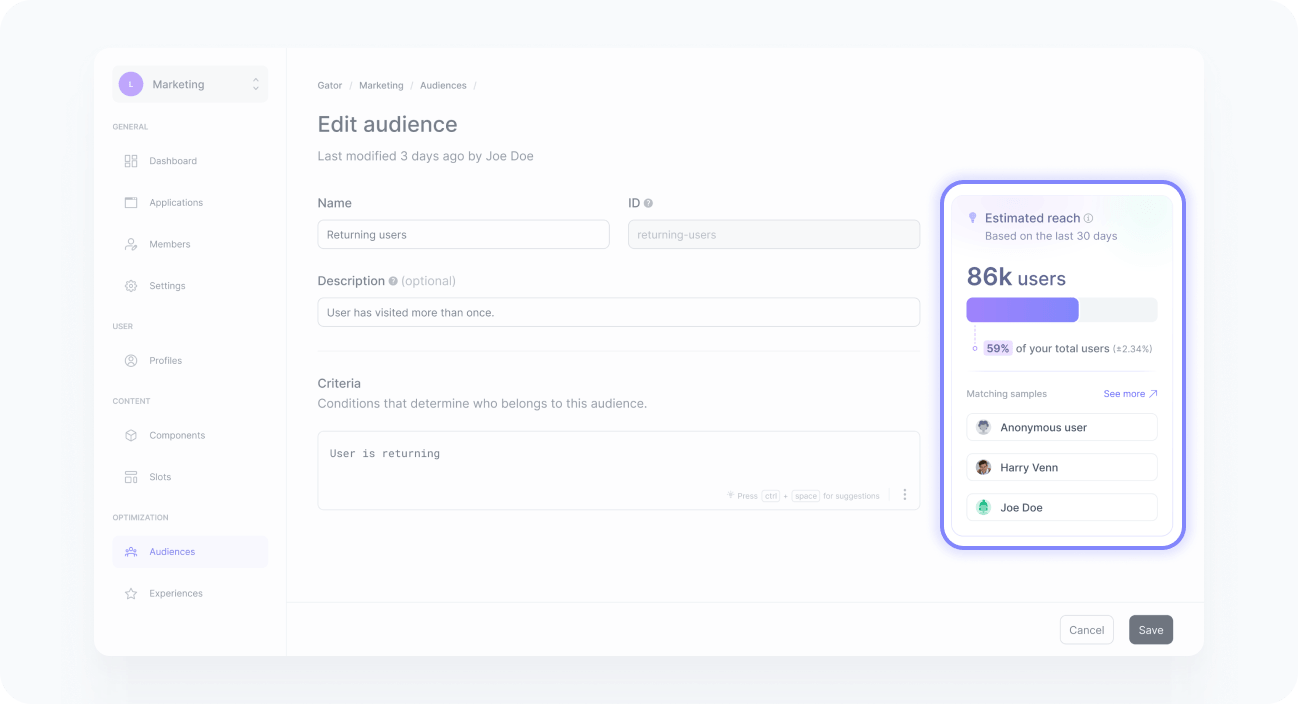
The audience estimator tells you what share of your user base currently matches an audience, so you can tell whether it is large enough to support a personalization strategy or an AB test before investing time in creating experiences.
It appears whenever you create or edit an audience, either from the experiences settings or from the audiences list, giving you immediate feedback as you refine your criteria.
This feature is available only to accounts on the Growth and Scale plans. See the pricing page for more information.
How it works
The audience estimator analyzes a representative sample of recent user profiles and evaluates how many of them match your audience criteria. The sample covers the last 30 days, or your account’s data retention period if it is shorter. Based on this sample, it estimates the percentage of your user base that currently fits the audience criteria. This approach provides results in seconds, even for very large datasets.
Because the estimate is based on sampling rather than evaluating every profile individually, the result is an approximation rather than an exact count. For planning personalization strategies and experiments, this level of accuracy is typically enough while keeping response times low.
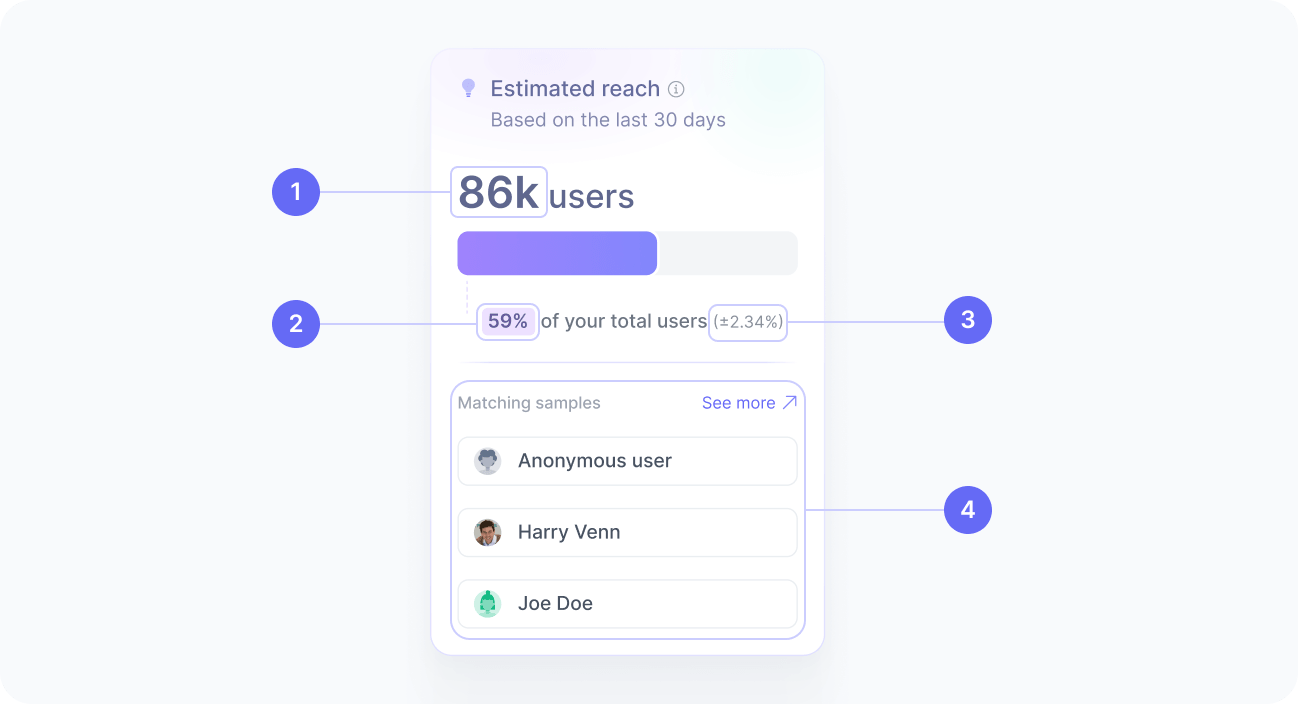
The card includes:
- Estimated users
The estimated number of users who currently match the audience criteria. - Estimated audience size
The estimated percentage of your user base that matches the audience criteria. - Margin of error
The confidence interval for the estimate, indicating how precise the result is. - Matching samples
Example user profiles that match the audience criteria, helping you validate whether the audience is targeting the expected users.
Margin of error
Every estimate includes a margin of error that reflects how confident we are in the result.
The margin is expressed in percentage points, not as a percentage of the estimate, so you add and subtract it directly from the estimated size:
Imagine an audience estimated at 12% with a margin of error of ±3 points. The real size is somewhere between 9% and 15%, not between 11.64% and 12.36%. For a user base of 200,000 users, that means anywhere from 18,000 to 30,000 users instead of the 24,000 shown as the estimate.
Smaller margins indicate higher confidence, while larger margins indicate greater uncertainty. The margin depends on factors such as the estimated audience size and the amount of data available for evaluation. Very small audiences naturally produce less precise estimates than larger ones.
Common issues
Some audiences cannot be estimated. Here are the most common reasons why this happens.
Unavailable estimate
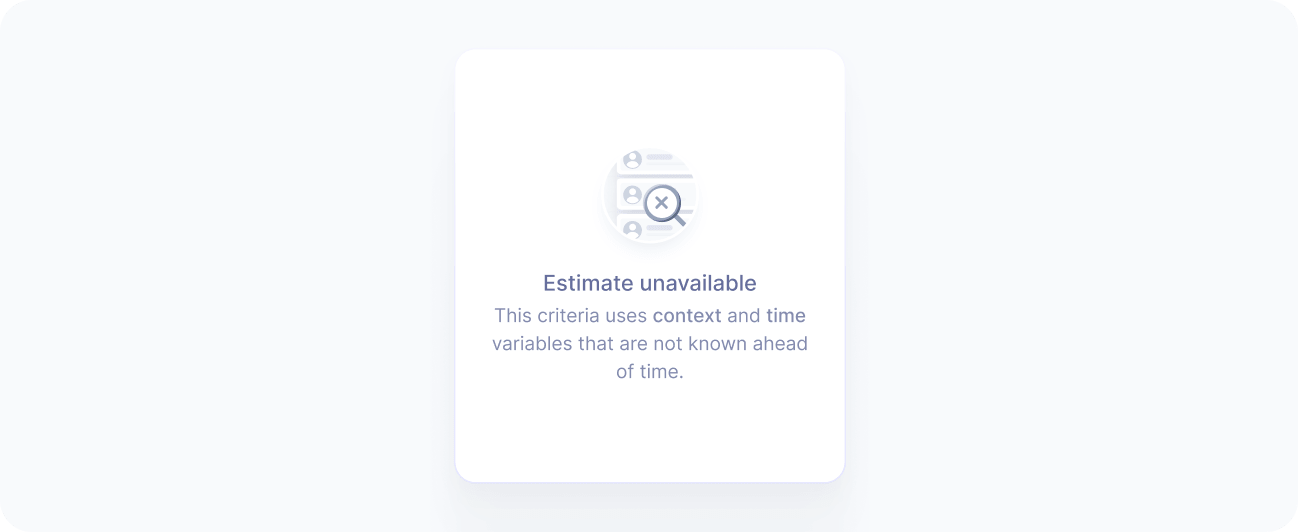
Some audience criteria cannot be evaluated using historical profile data, which makes it impossible to generate an estimate. This happens when the audience depends on context variables, such as the page the user is viewing. These values describe the user’s current browsing situation, so they are evaluated in real time rather than stored as permanent attributes.
The same applies to date and time variables like now, today, and yesterday, whose value depends on the exact moment the audience is evaluated and cannot be applied retroactively to existing profiles.
Because the audience estimator analyzes previously collected profile data, it can only estimate audiences whose criteria are based on information stored in the user profile or session behavioral history.
Audiences that use context, date, or time variables continue to work normally for personalized experiences and experiments. The limitation applies only to audience size estimation.
Not enough data yet
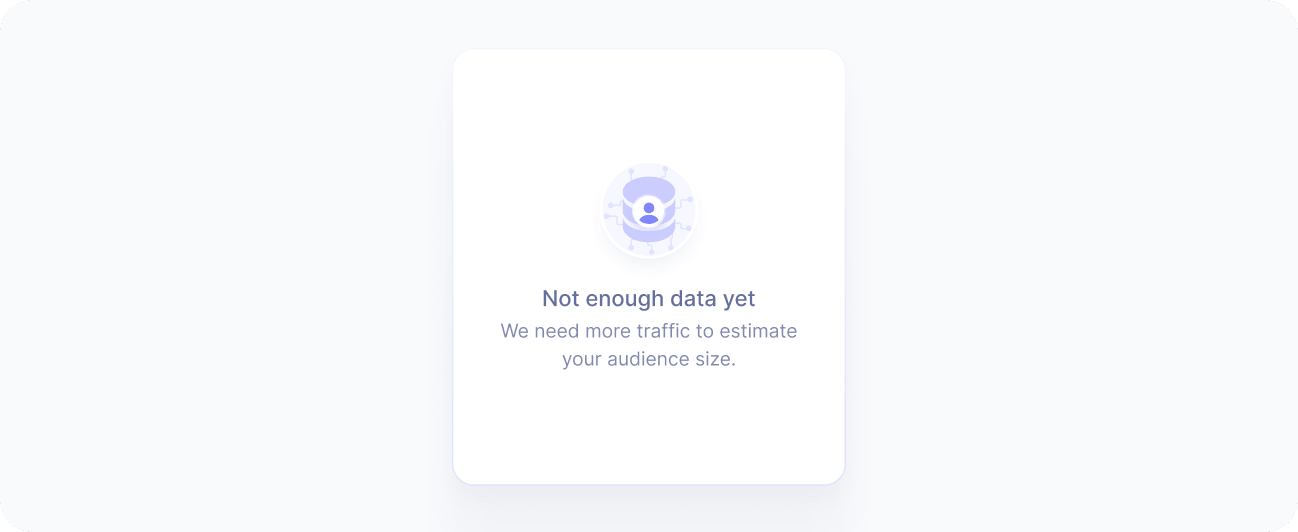
The estimator requires enough historical profile data to produce a reliable estimate.
If your application has only recently started collecting data or the selected criteria match too few users, we may not have sufficient information to generate an estimate. Continue collecting user data and try again later.